Trust that's verified, not assumed
CO-SYNE is built so that neither a driver nor an officer has to take anyone's word for who they are, and so that the record of what happened can't be quietly changed.
Credentials bound to the device
Officers hold a credential signed by their agency; drivers hold one signed by the state. Each is bound to an Ed25519 key created on the person's own device. The private key never leaves that device and is never sent to CO-SYNE.
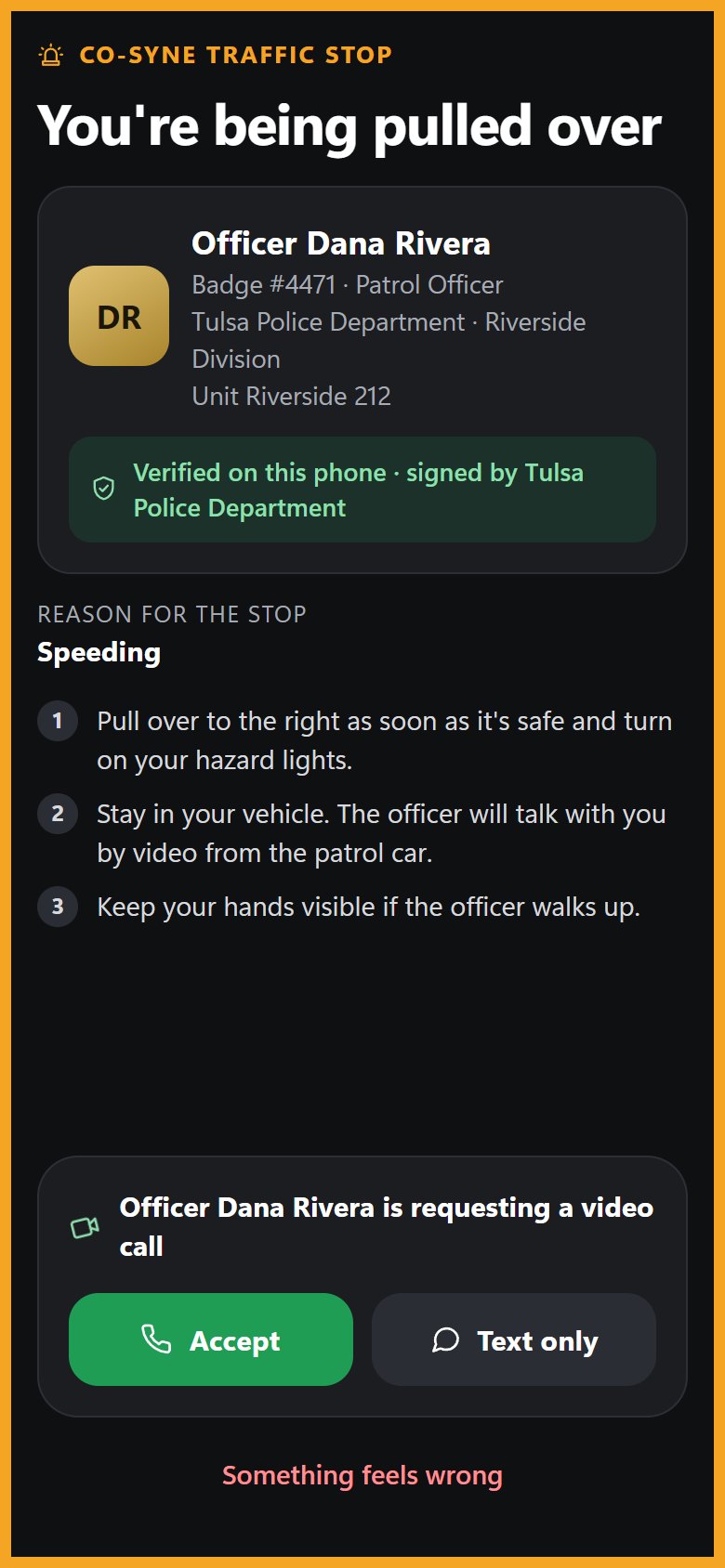
- Mutual verification at every stopBoth parties sign a one-time challenge for that stop. The server checks both, and the driver's phone checks the officer independently against the agency's published key.
- Impersonation is caughtA forged, expired or revoked credential, or a copied credential without its key, fails. The driver sees a red warning with safety steps, and dispatch is alerted.
- Instant revocationDispatch or the administrator can revoke a credential. The device is signed out immediately and can't verify at a stop again.

A record that can't be quietly rewritten
Every alert, routing decision, identity check, records query, video join, chat message, ticket, report and administrative action is written to an append-only ledger.
Hash-chained
Each entry includes the SHA-256 hash of the one before it. Editing, deleting or reordering any entry breaks every hash after it.
Signed
Each entry's hash is signed with the ledger's Ed25519 key, so someone who rewrites the file can't re-chain it without that key.
Verifiable by anyone
The whole chain can be re-checked at any time. The current status of this network is shown at the top of this page.
Recordings stay on the device
Video recordings stay on the device that made them. Their SHA-256 fingerprint is anchored in the ledger, so any later edit is detectable.
Sealed documents
Citations are signed by the officer's device key. Filed reports are hashed and sealed with the full stop timeline.
Audited access
Records lookups and every administrator sign-in and action are recorded, with who did it and when.
Only what's needed, only when it's needed
Stickers carry no personal data
The QR code on a vehicle holds only a link. Personal details are shown only on a verified officer's terminal during a stop, and that access is recorded.
Media flows peer to peer
The CO-SYNE server relays only the connection setup for video calls. Audio and video travel directly between the devices in the call.
Website inquiries stay private
Contact details sent through this website are kept separately for the CO-SYNE team. The public ledger records only that a message arrived.
Pilot transparency
The demonstration network uses sample identities, simulated records checks and simulated payments. Production deployments use the agency's and state's own issuers.
Frequently asked questions
What is CO-SYNE, and what is D2ES?
How does a driver know the officer is real?
Do I need the app to be open to get a pull-over alert?
What does the officer see about me?
What if I'm Deaf or hard of hearing?
Is acknowledging a ticket an admission of guilt?
What if something about a stop feels wrong?
Who can change the evidence record?
How do agencies join?
Does CO-SYNE work in rural areas?
Have a security question?
Our team is happy to walk your IT and compliance staff through the architecture in detail.