One network for the whole roadside
CO-SYNE is the interface and network connecting drivers, law enforcement, emergency responders and dispatch. D2ES is the AI-assisted emergency infrastructure underneath. Together they form one verified, real-time system.
How the pieces fit
Five components, each built for the person using it, sharing one core network.
Open the real apps
The demonstration network runs with sample Tulsa drivers and officers. Open each app in its own window, or on separate devices, and run a verified stop.

Driver app
Choose a demo driver, then wait for the officer's stop.

Officer terminal
Pick a pilot officer, open the Scanner and scan a sticker.

Dispatch console
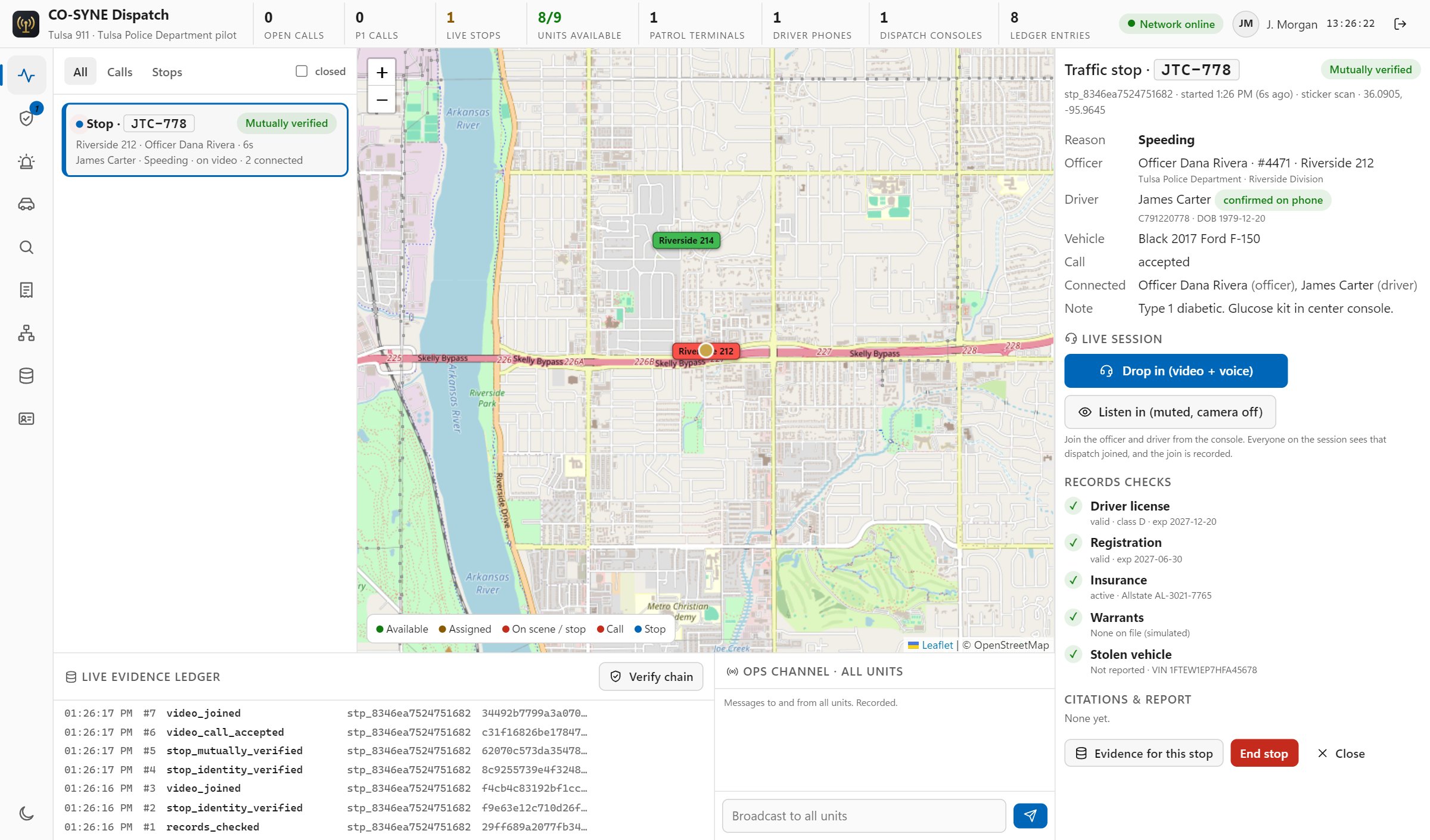
Sign in to watch the stop live and drop in by video. Ask us for the demo access code.

Side-by-side demo
All three apps in one browser window, for presentations.
Installing on phones and patrol terminals: see Downloads.
The CO-SYNE sticker
Every enrolled vehicle carries a CO-SYNE sticker. The officer scans it from the patrol car, and the stop opens with the driver's verified credential, with no plate typing and no approach needed.
- Bumper sticker · 11.5 × 3 inSized to be read by the patrol car's camera from behind the vehicle.
- Window cling · 4 × 4 inFor the rear window, for vehicles without a bumper location.
- Privacy by designThe code holds only a link. Personal data is never printed on the vehicle.
Shown to scale relative to each other. Sample code.
In-vehicle devices
Hardware in development to extend CO-SYNE into the vehicle itself. Register interest to hear first and to join hardware trials.
Vehicle camera
A dash camera that joins the stop's video session and anchors its recordings as evidence.
GPS and LTE beacon
Always-on location and connectivity for the vehicle, even when the driver's phone is not available.
Emergency button
A physical one-press D2ES alert that sends the vehicle's location and ID to the nearest center.
The Tulsa pilot
CO-SYNE's pilot runs on Tulsa geography, with urban and rural coverage through Tulsa 911 and north Tulsa County.
- Urban and ruralA metro dispatch center and a rural county center, each with its own units. Routing picks the nearest center and adjusts ETAs for rural roads.
- Local issuersPolice and sheriff's office issue officer credentials; the state issues driver credentials, all in the trust registry.
- Oklahoma violationseCitations use Oklahoma Title 47 violations. Fines and payments in the pilot are sample values.

Ready to see it on your streets?
We'll walk your team through the platform and plan a pilot that fits your agency.